



Times Higher Education Impact Rankings
The Times Higher Education Impact Rankings assess universities against the United Nations’ Sustainable Development Goals (SDGs). Carefully calibrated indicators provide comprehensive and balanced comparison across four broad areas: research, stewardship, outreach and teaching. The 2025 rankings evaluated 2,526 universities from 130 countries/regions, comparing their efforts to conduct teaching, research, outreach and stewardship that support a more sustainable, equitable and healthy future. The University of Minnesota system was ranked as follows in its 2025 submission:
Ranked #1
in the U.S. and tied for #16 in the world for our work related to clean water
Ranked #1
in the U.S. and tied for #54 in the world for our work related to promoting good health and well-being
Ranked #3
in the U.S. and #70 in the world for our work related to climate action
Ranked #3
in the U.S. for Partnerships for the Goals
Ranked #4
in the U.S. and #34 in the world for our work related to combating world hunger
5th
in the U.S. overall
Top 10%
worldwide
AASHE Sustainability Tracking, Assessment & Rating System™ (STARS®)
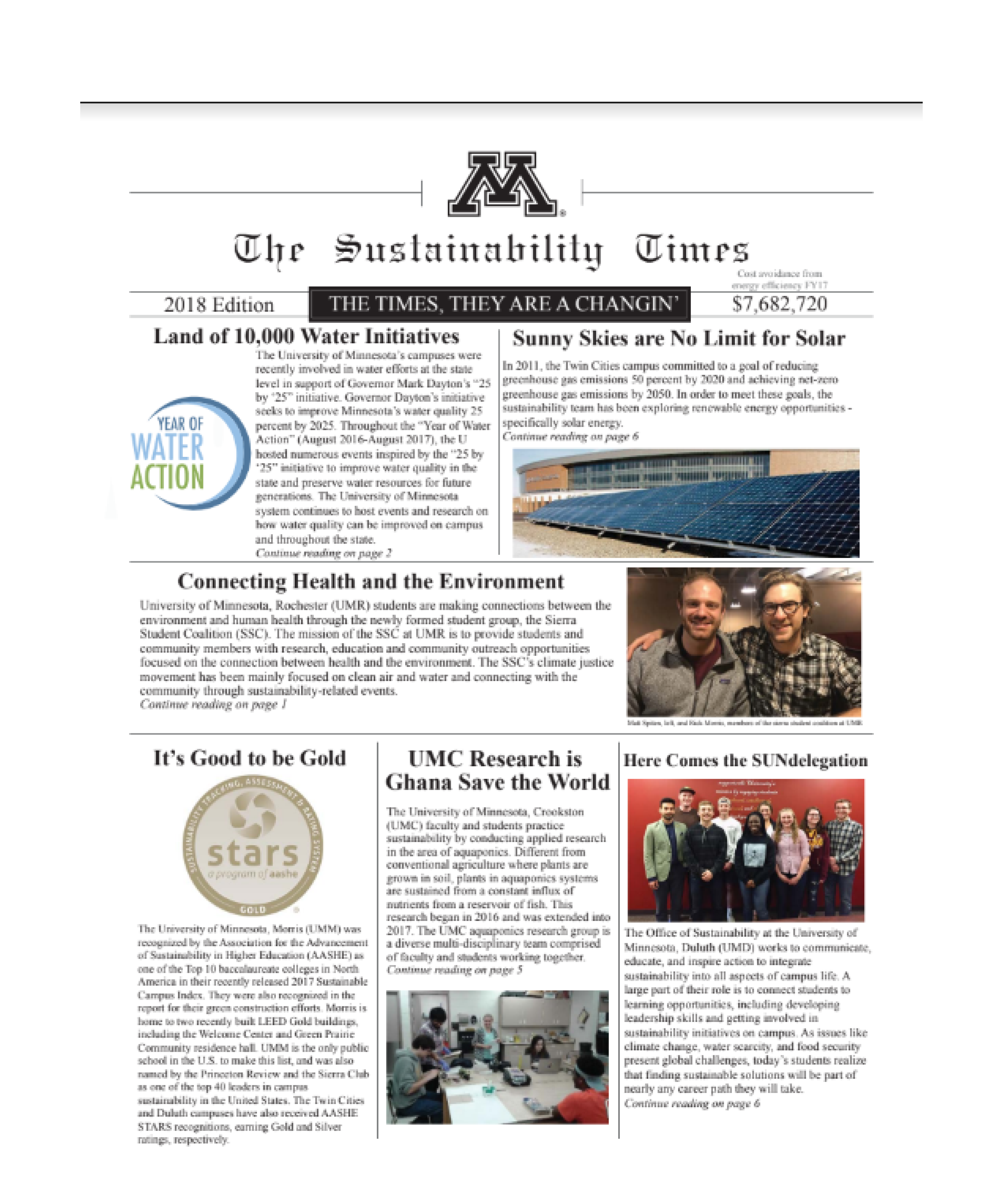
The University of Minnesota Twin Cities received a Gold rating on the Association for the Advancement of Sustainability in Higher Education (AASHE) Sustainability Tracking, Assessment & Rating System™ (STARS®) in 2026, demonstrating sustainability performance in research, curricular, co-curricular, operations, planning, and administrative categories. Each University of Minnesota campus pursued a Gold rating on the STARS® tool by 2025. This is the fifth STARS® submission by the Twin Cities campus since 2011 and the third Gold rating. The STARS® report will be publicly available in the near future.
Highlights of the University's score include:
Research
Full points were given for Center for Sustainability Research (6/6). Sustainability is infused across a wide array of research and community engagement centers at the University of Minnesota Twin Cities. To align with the University's threefold mission of research and discovery, teaching and learning, and outreach and public service; research and community engagement centers touch upon a host of fields, from climate resilient agriculture to socially equitable health, to designing the sustainable energy resources of the future. Examples include the The Center for Planetary Health and Environmental Justice, the Institute on the Environment, the Center for Sustainable Building Research (CSBR), the Center for Sustainable Polymers, the Center for Science, Technology, and Environmental Policy at the Humphrey School, Saint Anthony Falls Laboratory, and the Interdisciplinary Center for the Study of Global Change, among numerous others.
Curriculum
Full points (4/4) were earned for having solutions-focused applied learning or living laboratory experiences for students that address sustainability challenges. UMN Twin Cities offers a wide variety of applied learning opportunities for students that address sustainability challenges. Programs include: Stop the Thud, which monitors birds across campus; exploring campus shell and roof opportunities for innovative/artistic solar installations; and mapping ecosystem services of campus green space. The Office of Sustainability’s Living Lab page features materials to aid students, faculty, and staff in the development of proposals.
Engagement
The University of Minnesota Twin Cities received 23 out of 25 points in the Public Engagement category for programs that support student and faculty/staff civic engagement, sustainability-focused community partnerships, support for continuing education opportunities within the state, publicly accessible facilities such as the Weisman Art Museum that provide cultural services, and for sharing our sustainability experiences and expertise with peers.
Health Safety & Wellbeing
The University of Minnesota Twin Cities received 3 out of 3 points for fostering a holistic approach to student and employee health, safety and wellbeing by offering student and staff wellbeing and assistance programs through Boynton Health, Lyra Health, the Earl E. Bakken Center for Spirituality & Healing, the USenate Safety Committee, emergency assistance programs for students, and initiatives to address food insecurity such as the Nutritious U Food Pantry.
Materials Management
UMN Twin Cities received 3.75 out of 4 points for the extensive programs in place which responsibly manage and recover materials that are hazardous, repairable, recyclable, and minimize the use of single-use disposable plastics.
- The ReUse Program collects surplus items from over 250 buildings, redistributing furniture and equipment valued at over $200,000 to UMN departments each year.
- Over 1200 pounds of organics from on-campus dining, research facilities, and public space are collected annually by Waste & Recovery Services, making UMNTC home to one of the most robust composting programs in the Big 10.
Building Design & Construction
The University of Minnesota Twin Cities was recognized with 2.81 out of 3 points for the incorporation of leading-edge sustainability requirements and standards into the design and construction of buildings on campus. The sustainable building guidelines used in state-funded projects is called B3 (Buildings, Benchmarks, & Beyond), developed collaboratively by the UMN’s Center for Sustainable Building Research alongside the Minnesota Department of Commerce and Department of Administration. B3 guidelines include the SB 2030 Energy Standard, a progressive energy conservation program designed to significantly reduce the energy and carbon in MN buildings.
Coordination & Planning
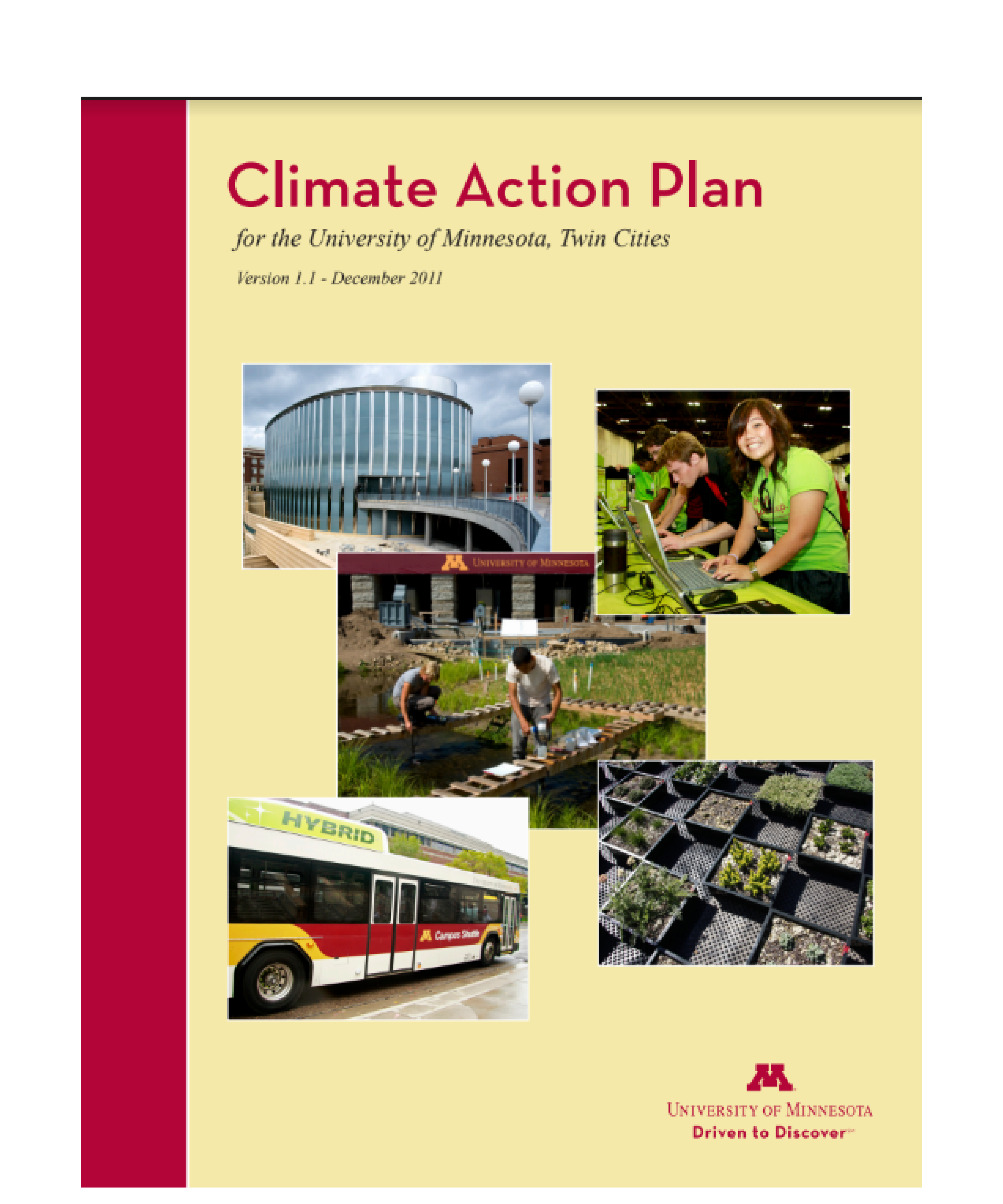
The University of Minnesota Twin Cities received 10 out of 11 points for establishing sustainability coordination and planning across campus. UMN Twin Cities has built a bedrock foundation and cumulative momentum for sustainability and climate action leadership since the The Board of Regents set a sustainability policy in 2004. The University succeeded in meeting the 2011 Climate Action Plan goal of a 51% reduction in emissions and currently pushes harder towards decarbonization through the goals established in the 2023 Climate Action Plan. Significant work and research has already been catalyzed by the plan, including additional on-campus renewables and hybrid buses, strategy to expand and protect tree canopy on campus, establishment of a task force for vulnerable populations, workplace safety updates, and research alignment for updated building standards.
Other Awards and Achievements
Highlights include:
- 2026 Northrop achieves LEED Gold certification for sustainability efforts; University of Minnesota Twin Cities
- 2025 University of Minnesota System places first in the US in the Times Higher Ed (THE) Impact Rankings for its work related to clean water and health & well-being
- 2024 U of M System ranks fifth in US in sustainability impact, among the top 10 percent worldwide, and among the top five in the U.S. in the categories of clean water, climate action, zero hunger, and health and well-being in the Times Higher Ed (THE) Impact Rankings; Huntington Bank Stadium and University of Minnesota recognized as Waste Leader for 50%+ diversion from landfill by the Green Sports Alliance; Twin Cities campus designated a Tree Campus in Higher Education by the Arbor Day Foundation, a recognition of its abundance of well-cared-for trees
- 2023 University of Minnesota Twin Cities receives STARS® Gold rating; UMN Twin Cities has the highest waste diversion rate in the Big Ten at more than 55%
- 2022 ULSCA Sustainability Award for the U Market Services Package and Waste Reduction project
- LEED certified buildings on campus include Bruininks Hall (Gold) and Huntington Bank Stadium (Silver), which was the first LEED Certified football stadium in the country
- 2022 Award for Sustainability in Healthcare Management Education and Practice - UMN School of Public Health
- 2022: University of Minnesota is #23 in the EPA's Top 30 college and university Green Power Partners list
- 2021 Bicycle Friendly University Platinum Award and Bicycle Friendly Business Platinum Award from the League of American Bicyclists, in recognition of the University’s achievements in promoting and enabling safe, accessible bicycling on campus
- 2020 Twin Cities campus earns Bee Campus USA designation
- 2019 ACEC of Minnesota Honor Award: University of Minnesota Combined Heat and Power Plant
- 2018 Minnesota B3 Best of B3 IEQ - Workplace: UMTC Recreation and Wellness Center Expansion
- 2017 Minnesota B3 Best of Leadership: University of Minnesota Twin Cities
- 2017 Accredited Sustainable Fleet Award from the National Association of Fleet Administrators (NAFA)
- 2016 Top Project: University of Minnesota Bee and Pollinator Lab
- 2015 Top Project: M Health Clinics and Surgery Center
- 2015 University of Minnesota Twin Cities receives STARS® Gold rating
- 2014 CenterPoint Energy Most Innovative Project of the Year: University of Minnesota CHP Plant
- 2010 Xcel Energy Efficiency Expo: Largest Electric Savings - Commercial Customer: University of Minnesota, 1796 kW
- 2003-2006 Chicago Climate Exchange recognition for achieving the highest compliance standards for greenhouse gas reductions available in North America today