Stop the Thud: Preventing Bird Strikes at the University of Minnesota
Each year, one billion birds in the US die when they collide with glass windows and doors. The University is located on the Mississippi Flyway, an important migratory route for birds during the fall and spring. With the correct precautions, these collisions with campus buildings are preventable. The University of Minnesota Bird Safe Campus initiative includes two campaigns, Stop the Thud and Lights Out for Birds, and aims to keep our migratory birds safe by reducing the number of bird strikes on campus.
Current Bird Safety Initiatives
Stop the Thud - Preventing Bird Collisions
The University of Minnesota Twin Cities has made a commitment to reducing bird collisions with University buildings by pledging to retrofit buildings which have established patterns of bird-glass collisions and by ensuring that new buildings and renovations are compliant with bird-safe guidelines. One way we can all help support this effort, especially during migration season, is by making sure that interior lights are turned off at the end of the day. This is especially important for higher floors that are directly in line with bird flight patterns. Turning off interior lights that are not necessary for security purposes at night not only saves bird lives but it also saves money and energy.

Though these might seem small steps to take, reducing collision induced mortalities at the University of Minnesota could have profound impacts towards promoting continued health and biodiversity of birds in the state. The University of Minnesota Twin Cities lies within the “Mississippi Flyway” – an important migratory corridor that many of Minnesota’s bird species follow during their migration periods. By making sure that birds can see and avoid the numerous windows on our campus buildings, we can greatly reduce the hazards that migratory birds face when they come through the University of Minnesota to rest and feed. With your support, we can decrease these fatal bird strikes and secure energy savings for our campus.
Report a Bird Collision Visit the Story Map

Lights Out for Birds
Each year up to 325 bird species utilize the Mississippi Flyway as they migrate north in the spring and south in the fall. Oftentimes flying at night, migratory birds get disoriented and confused by bright city lights and skyglow. This confusion can make birds more susceptible to building collisions. Lights Out programs aim to mitigate bird collisions by encouraging the campus community to turn off excess lighting during peak migratory seasons.
Best Practices for Lights Out
- Turn off excess interior lighting, especially on higher floors
- Reduce interior atrium lighting
- Reduce excess exterior lighting
- Close window blinds or shades at night
- Utilize warm lighting vs cool bright white lighting
- Direct outdoor lighting downwards and outwards vs upwards towards the sky
- Utilize motion sensors for interior and exterior lighting whenever possible
- Turn off decorative landscape lighting during peak migration
Check out resources like BirdCast to see migration forecasts and receive alerts when migration traffic is predicted to be high.

Standards for Bird Safety Included on All New Construction or Major Building Renovations
All new building construction or renovations must follow B3 Standards. B3 (Buildings, Benchmarks, and Beyond) Guidelines are a set of standards created specifically for buildings in the state of Minnesota. B3 Guidelines are applied to construction and renovation projects to meet sustainability goals for site, water, energy, indoor environment, materials and waste.
Example buildings:
- Microbial Cell Production Facility, St Paul Campus - bird safe glazing at the corners and dangerous areas for bird strikes (not on every window)
- Fraser Hall Retrofit, East Bank - extensive bird glazing on windows
- Other examples: Bell Museum, Bruininks Hall, Campbell Hall (not entirety of building and the side with patterned glass is not entirely effective at stopping collisions)
Previous Projects / What has been done in the past
There are other DIY solutions being implemented on campus, some are more effective than others. 2 in. x 2 in. pattern of dots applied to the exterior of the glass is shown to be the most effective in mitigating bird strikes (Klem, Daniel; Audubon; U.S. Fish & Wildlife Service)
St. Paul Campus
- Ruttan plaza (tape on glass railings)
- Cargill Building (tape on glass linkage)
- Green Hall ("woodland scene" patterned decal that entirely covers linkage to Skok Hall)
- Coffey Hall (bird decals in lower-level window)
- Food Science and Nutrition (raptor silhouettes in window above door)
- New Bell Museum bird safe glass
- Experimental film applied on north-facing windows on Coffey Hall and Ruttan Hall
West Bank
- Blegen hall skyways (both skyways attached to Blegen Hall have cords hung in front of them)
- Experimental film applied to skyway between Blegen Hall and Social Sciences Hall
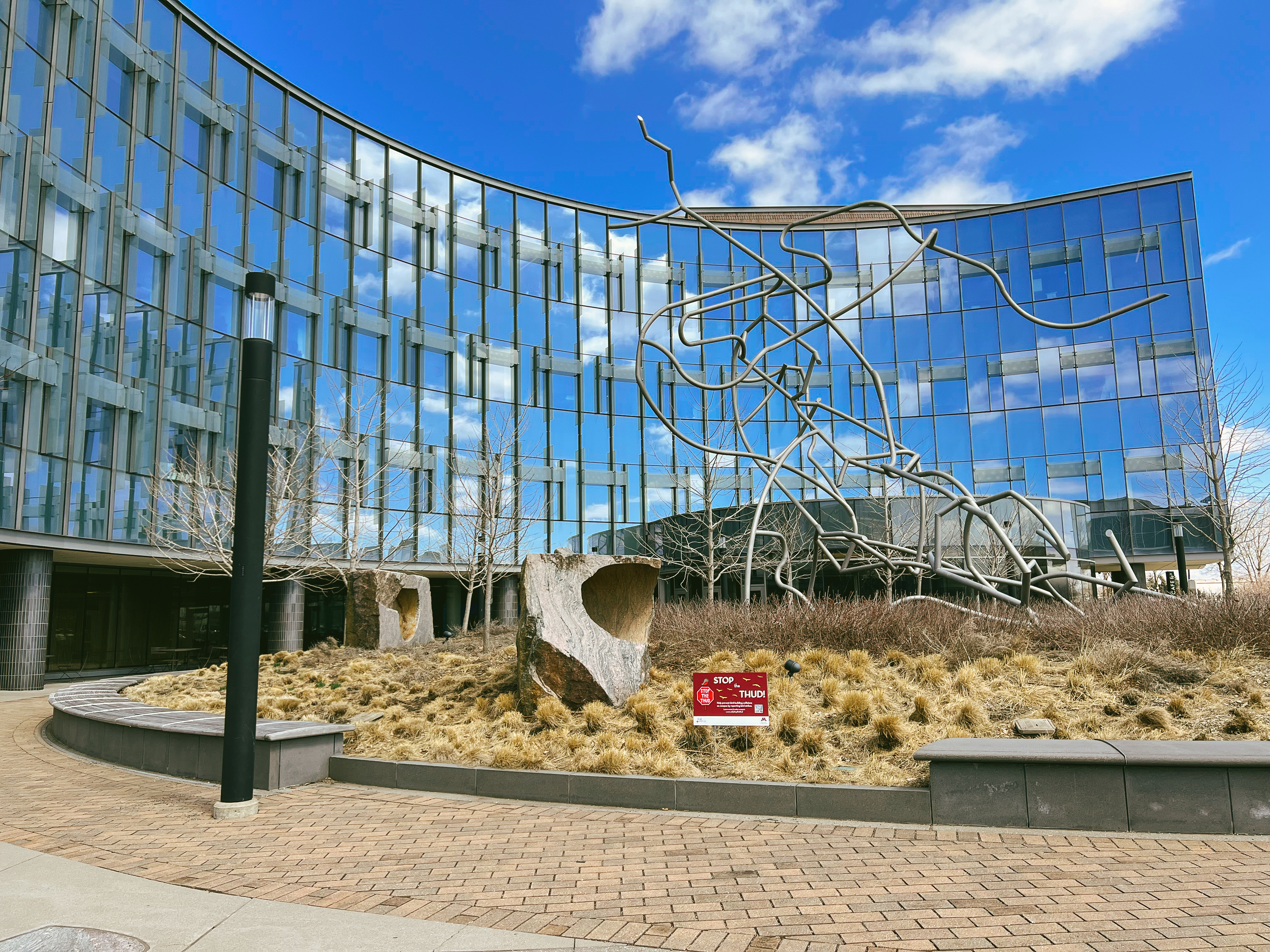
Cancer and Cardiovascular Research Building (CCRB) Feasibility Study
- In 2023 the University contracted a feasibility study of the Cancer and Cardiovascular Research Building (CCRB) to explore possible retrofit options to decrease bird collisions with the building. It was determined that the financial cost to apply bird deterrent film to the exterior glass facade was too high to implement at this time.
Previous research done by UMN faculty, staff, and students
Challenges
Preventing bird collisions on campus has its challenges. Variables like cost, film application, lighting schedules, and our location on the Mississippi all need to be taken into consideration when selecting strategies to mitigate urban hazards to migratory birds.
Cost of external film application
One of the most effective strategies for mitigating these collisions is applying a bird deterrent film to windows and skyway glass. The application process can be financially costly due to the fact that film must be applied to the exterior of the glass for it to be effective. This process often involves the use of scaffolding and other means to reach windows of tall buildings and skyways.
Urban skyglow
The University of Minnesota Twin Cities is located within the larger Twin Cities metropolitan area.This proximity allows urban skyglow from the city to be visible on campus. We can control our own lighting but do not have control over lighting sources off campus.
Funding
As mentioned above the cost of applying bird deterrent film to the exterior of campus buildings and windows can be very costly. The University does not currently have a funding mechanism in place for bird safe building projects and has limited resources to address bird safety issues with existing buildings.
How can you help?
There’s always a way to make a difference. Turn off lights at night, report collisions, try simple DIY window fixes, and–if safe–donate found birds to the Bell Museum’s Salvage Program to support research and education on environmental health, ecology, and conservation to "bolster our understanding of how wildlife respond to changing environments, contribute to informed management decisions, and build a strong system of monitoring for big issues."

Questions? Contact [email protected]