University of Minnesota Winter Salt Use
Facilities Management’s Landcare team is the primary snow removal service provider for the University of Minnesota Twin Cities campus, responsible for clearing nearly 100 miles of streets and walkways, and over 100 acres of parking surfaces. The Landcare team added an anti-icing agent to the University’s winter maintenance program back in 2006. This led to cost savings and reduced environmental impact. The Landcare team completes Smart Salting training through the Minnesota Pollution Control Agency, and in all operations, the Landcare team works hard to balance the importance of public safety with thoughtful stewardship of natural and constructed resources on our beautiful campus.
“There is pressure to apply more salt for the social and safety aspects of icy roads and sidewalks. But there are also the ecological impacts and the pressure to limit salt use, along with the degradation of campus infrastructure that comes with too much salt use ” - Tom Ritzer, Assistant Director of Landcare.
Process
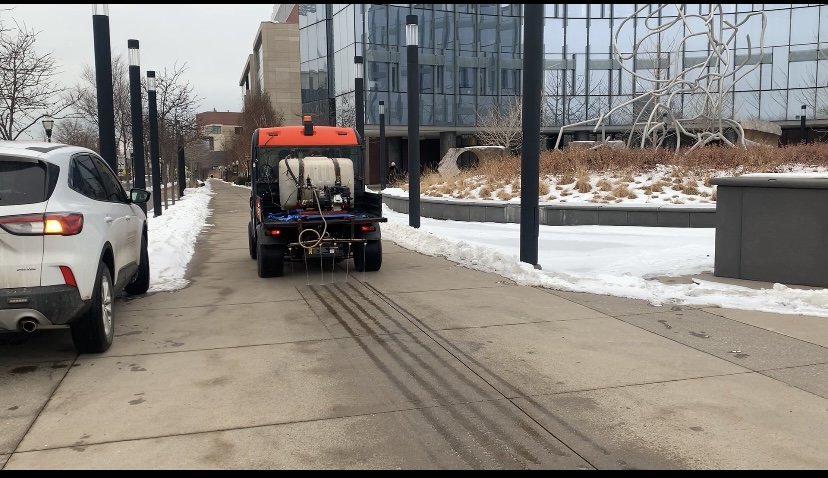
The Landcare team monitors the weather conditions to make a plan of attack, using data from NOAA and University weather response notifications. This gives Landcare a better understanding and context to the weather. They coordinate all possible predicted weather conditions, events on campus, and staff availability to ensure they are prepared for the weather conditions. Before a forecasted snowfall, Landcare sprays salt brine anti-icing agent on roads and sidewalks. They pre-wet this treatment, by adding water to the salt, to enhance the effectiveness of the treatment. Pre-wetting speeds up the time it takes for the salt to work, salt needs to be wet to bind to reduce ice, and is more effective, allowing them to use less. This brine solution prevents ice layers from forming and bonding with the surface of the roads and sidewalks, making removal of accumulated snow easier and more efficient, and reducing the need for additional salt applications. The use of anti-icing solutions allows the University to cut salt and sand use by several hundred tons per year, thus saving thousands of dollars, improving air quality, decreasing silt build-up, and reducing harmful runoff to stormwater systems and receiving water bodies.
Intermittently before applying treatment, the Landcare staff calibrate their equipment to accurately apply and reduce the amount of salt needed. Most of their work is being proactive to prepare for snow or freezing weather events.
Watch this video to see the process!
If you see white lines on roads or sidewalks on campus, you know that the surface has likely been pretreated by Landcare. The lines give a wider range of concentration for the anti-icing to be as effective as possible. As always, be sure to practice safe winter habits, Gophers!

Comparisons
Salt brine is different from road salt that we typically use and think of. Salt brine is a solution of sodium chloride and water that is very useful in reducing the adhesion of snow and ice to road surfaces. It has a freezing point below water so it can stop snow from freezing to the pavement surfaces. It is an anti-icing, proactive approach that decreases the amount of snow and ice that sticks to a pavement surface in the first place. Anti-icing involves placing a layer of bring on the surface of pavements before a storm has hit to prevent ice from freezing to roads. Road salt on the other hand, is crystals of sodium chloride and does not stop/prevent snow from freezing to pavements. Road salt is a deicing, reactive approach that retroactively works to remove snow and ice from pavements. Deicing uses road salt to break up snow and ice after it has frozen to the road. Therefore, the Landcare team using a salt bring anti-icing approach is more proactive and efficient.
Environmental Impacts
With the many benefits that salting provides, there are harmful environmental impacts to consider. Salt can have adverse effects on nearby environments and groundwater sources. (MNDOT) most of the salt placed on roads, parking lots, and driveways ends up as water runoff.
“A University of Minnesota study found that 78% of the salt placed on roads stays in the MSP area, entering lakes and streams, or flowing into our soils and eventually the groundwater. The chloride makes the water taste salty, and ruins habitats for freshwater aquatic species, such as fish and clams.” (UMN) This is because chloride in high amounts affects the oxygen levels and natural mixing of lakes and waterways, which not only ruins habitats but is toxic to aquatic life.
Road salt can contaminate drinking water, kill or endanger wildlife, increase soil erosion, and damage private and public property. Sodium chloride (table salt) is the most common substance used for deicing roads and sidewalks. The salt can infiltrate nearby surface and ground waters, contaminating drinking water reservoirs and wells. High sodium levels in water affects people with high blood pressures when found in drinking water. It can be toxic to fish, bugs, and amphibians when found in surface waters. Salt can accumulate on roadside areas harming roadside plants and wildlife that eat the salt. (EPA)
To reduce these environmental impacts, Smart Salting training helps reduce chloride pollution by reducing salt use from 30-70%! All while keeping roads, parking lots, and sidewalks safe. This training has been shown to prevent chloride contamination in water bodies. The Landcare team has also evolved their practices over time to be more efficient in their application of salt, reduce costs, and reduce impacts on the environment.
“Over the last 15 years, we have evolved to be more sustainable in the use of chlorides in our anti-icing program, we utilize the MPCA Smart Salting Program, reduce the use of sand which has other environmental impacts on stormwater, and have researched deicing products to find the most effective chemical blends to use less altogether.”- Tom Ritzer
How Much Salt is Needed?
If needed, apply deicing salts correctly and sparingly. One teaspoon of salt will pollute 5 gallons of water! Read the product label and apply as directed, included at the proper temperature. Only about 12 oz is needed for 1000 square feet, approximately the area of a 20 foot driveway or 10 sidewalk squares! Remove snow first before applying deicers. Spread salt evenly, leaving 3 inches between salt grain and avoid spilling piles of salt. Sweep up all salt grains on dry surfaces to prevent it from washing into storm drains or waterways. (UMN Extension)
What can YOU do?
Know that more is NOT better! Deicing salts are LESS effective when applied in excess. Shovel, scrape, and sweep snow often to remove as much of it and prevent ice buildup. If it’s a warmer day, let any remaining snow or ice layers melt. Be like the University of Minnesota and reduce your deicing salt use when possible!
Welcome back to campus! Here’s what’s coming up in our Sustainability Coffee Chats series this fall:
- ☕ Sept. 28, 9 to 10 a.m. — Learning Abroad, SDGs & Sustainability
- ☕ Oct. 15, 9:30 to 11 a.m. — Planetary Health 📍 IN PERSON at RecWell (Register)
- ☕ Nov. 18, 9:30 to 10:30 a.m. — Native American Medicine Garden (Register)
- ☕ Dec. 1, 12 to 1 p.m. — Ask Me Anything: Leading Through Sustainability & Climate Action with Shane Stennes, Chief Sustainability Officer (hosted by the Alumni Association) (Register)

Welcome, new and returning students! Did you know that students and faculty at the U have access to a Universal Transit Pass included with student fees, so you can explore the Twin Cities sustainably? The Coffee Passport has directions to coffee shops owned by ethnically diverse communities, less than 15 minutes away from the East Bank. Together, we can save time, money and CO2 emissions to achieve the U’s Climate Action Plan of reducing commuting emissions by 40% by 2030. Download the Coffee Passport.

Join and on July 15 from 9-10 a.m. at for the groundbreaking of the first of seven new solar installations planned for the Twin Cities campus. It's an exciting milestone as we continue expanding renewable energy and advancing our Climate Action Plan.
By Sunhari Jacob, Student Engagement Strategy Assistant
The 2026 Campus Conservation Challenge engaged more than 220 students in reducing residence hall energy use, resulting in measurable savings and increased sustainability engagement. The challenge demonstrated how collective action can create meaningful environmental impact on campus.

The University of Minnesota Twin Cities has received a STARS® Gold rating! The Sustainability Tracking, Assessment & Rating System™ (STARS®) Gold rating from the Association for the Advancement of Sustainability in Higher Education (AASHE) recognizes the long-term sustainability goals and performances for all higher education. Read the extended summary.

Check out an EV from HOURCAR and an electric Chevrolet Equinox from Fleet, and test ride bikes from Lime and scooters from Spin. Ice cream from the University Meat and Dairy Salesroom available while supplies last! Wed. May 27, 11 a.m. to 2 p.m. at Lilly Plaza.
Join the University of Minnesota Twin Cities for Bike to Work Day on Tuesday, May 12 from 8 to 10 a.m. and show your support for sustainable commuting! Whether you're a seasoned cyclist or just getting started, this is the perfect opportunity to enjoy the ride, connect with fellow bikers and get rewarded for your pedal power. Stop by these two campus locations for FREE treats, giveaways and services:
- University Bike Center at Oak Street Ramp
- Pleasant Street SE at University Avenue
Upcoming Coffee Chat: Student Project Spotlight
Monday, May 4, 11:30 a.m. to 12:30 p.m.
Our Sustainability student staff have been busy this semester! Join us to hear everything about student sustainability work happening at the Twin Cities and University Sustainability offices.
Speakers:
- Diya Shah - Graduate Student & Data Analyst Intern, University Sustainability
- Ella Chilson - Student Sustainability Assistant, University Sustainability
- Giselle Muñoz-Semple - Student Sustainability Assistant, University Sustainability
- Cole Becker - Student Sustainability Assistant, University Sustainability
- Yvonne Mongare - Undergraduate Student & Climate Resilience Public Health Task Force Coordinator, Focus on Vulnerable Communities, Office of Sustainability at Twin Cities
Recording coming soon

As Northrop approaches its centennial in 2029, the University of Minnesota landmark has reached a major milestone: one of the University’s most iconic and historic buildings is now Leadership in Energy and Environmental Design (LEED®) v4.1 Operations + Maintenance (O+M) Gold certified.
Northrop is the first University of Minnesota facility to achieve LEED Gold under this rigorous standard for existing buildings. The certification reflects Northrop’s commitment to honor its historic legacy while building for the future, demonstrating that sustainability is not limited to new construction. Historic buildings can also evolve, improve and lead. Read more about Northrop’s LEED Gold certification and what it means

Today, on World Health Day, University of Minnesota President Rebecca Cunningham signed the Okanagan Charter, making the University a designated Health Promoting Campus.
The signing ceremony took place during the University’s Climate Resilience Teach-In, heralding the organization’s commitment to prioritizing health and sustainability. Read more about the University's commitment to the Okanagan Charter